APPLIED VISION BASEBALL
PITCH RECOGNITION MASTERCLASS.
4 LESSONS THAT WILL MAKE YOU BECOME A PITCH RECOGNITION EXPERT.
Each Lesson Below Was Designed To Help You Understand The Vision Performance Aspect of Hitting A Baseball.
If You Enjoyed It, You'll Love The Vision Training App!
Why You Need This Guide
It doesn't matter how perfect your swing mechanics are or how confident you feel at the plate; if you're not seeing the ball well, your mechanics will break down, and your confidence will shrink.
In order to cultivate the belief that you have what it takes to beat the pitcher, your pitch recognition and swing decisions have to be sharp.
By the end of this pitch recognition crash course, you will understand the main core principles that you'll find demonstrated in hitters with off-the-charts pitch recognition skills.
Let's get started!
Highly recommended! Perfect mechanics mean nothing if you're not confident and not seeing the ball great. You can rehearse success with this app. Love it."

Steve Springer
@qualityatbats
"When your eyes improve, you improve! This app has been great for helping hitters learn how to stop chasing pitches in the dirt."

Trent Mongero
@coachmongero
This app gave me a great opportunity to work on my pitch recognition in my room. When I can't go to the facility or field, I have this right at my fingertips!

Caleb Pendelton
@cpendleton34
LESSON 1
CUT YOURSELF SOME SLACK
Hitting is hard.
It takes roughly 400 milliseconds for an average MLB fastball to reach home plate.
It takes about 100 milliseconds for your brain to process the release point.
It takes around 25 milliseconds for your brain to tell your body to swing.
An average MLB swing is about 150 milliseconds.
That means you have about 150 ms to recognize the spin, speed, and location of the ball, to put a quality swing at where you think the ball will be at the point of contact.
PREDICTION SKILLS ARE EVERYTHING
How good a hitter is at swinging at where the ball will be once it hits the strike zone, based on the information they collect from the ball at the release point, will dictate:
Researchers have used "flash drag illusions" to demonstrate how our brains have a natural tendency to predict the motion of moving objects.
In the video below, you can see how your vision naturally attempts to predict the movement of the dots based on the movement in the background.
Keep in mind: The dots stay in the same place the entire time.
LESSON 2
3 PITCH RECOGNITION SOLUTIONS
Problem: Swinging at Junk
You swing at junk, get fooled by secondary pitches, or misread strikes vs balls — all because your vision processing is outpaced by what’s happening in front of you.
Solution: Strike Zone Awareness
AVB includes a “strike-zone awareness” overlay and pitch-recognition drills that force you to distinguish ball vs strike under time pressure using real hitter’s-perspective video.
You become more plate-disciplined. You force pitchers to work harder. You swing fewer times outside the zone and more on pitches you can drive — increasing your hard contact % while decreasing your chase-rate.
Problem: Slow Pitch Processing
You see the pitcher release the ball, but your brain can’t reliably parse spin, speed, or location fast enough. Too often, you’re late or wrong — chasing bad pitches, missing barrels, or freezing in big moments.
Solution: Simulate Live At-Bats
The AVB app simulates live at-bats with elite pitchers across thousands of pitch sequences, and offers drills (occlusion, swing-trigger, soft-to-hard focus, pitch path prediction) to train your visual system to “read” the ball earlier.
By training your vision first, you can allow what you work on in practice to translate to the game. Now you have the belief that you can beat the pitcher!
Problem: Tension and Anxiety Create Poor Vision Performance.
You’ve stepped in the batter’s box full of tension, pressure and anxiety - making it almost impossible to recognize spin, speed and location of pitches at point of contact. In other words, the game is too fast.
Solution: Access to 1,000+ Reps
You train your pitch-selection, swing decision, and prediction skills in the Applied Vision Baseball App by simulating 1,000's of different pitch-sequences.
Now you can compete in the batter’s box with calmness, toughness and focus with the belief that you have what it takes to beat the pitcher.
LESSON 3
HOW DOES SWING DECISION TRAINING WORK?

Inside the drill, hitters learn to anticipate where the pitch will finish, not where it starts. Pitches that end in the upper green zone represent mistake pitches that can be driven and should trigger an immediate “yes.”
Pitches that finish in the lower red zone are designed to induce chase and must be taken. This visual contrast trains the brain to separate hittable from unhittable pitches earlier in flight.
The efficacy of the Post-Up Drill comes from constraint-based learning: by limiting movement and narrowing the visual objective, hitters develop cleaner yes/no decisions, reduced chase rate, and improved hard-contact quality. Rather than teaching discipline through reminders or willpower, the drill builds discipline through better visual prediction and timing, which is exactly what transfers to live at-bats.

The Swing Trigger Drill is built for hitters who are consistently late, indecisive, or swinging at the wrong pitches despite having solid mechanics. The issue isn’t the swing—it’s the timing of the decision. This drill isolates the exact moment a hitter commits so that decision speed becomes trainable and measurable.
Hitters track the pitch early and commit to either yes, yes, go for strikes or yes, yes, no for balls. The objective is to pull the trigger on strikes as early as possible while shutting the decision down cleanly on pitches outside the zone.
Every rep is measured in milliseconds, showing both the ideal reaction window and the hitter’s actual reaction time, creating immediate, objective feedback.
The efficacy of the Swing Trigger Drill comes from compressing the decision window under game-speed pressure.
Hitters learn what an on-time decision actually feels like, not just what it looks like on video.
Over time, earlier and more consistent trigger timing leads to better pitch selection, improved contact quality, and fewer late, defensive swings in live at-bats.

In the Soft Focus → Hard Focus Vision Drill, you train how and when your eyes sharpen during pitch flight.
The drill begins with a white circle on the pitcher’s body, training soft focus—a relaxed, wide visual state that helps you pick up early cues like tempo, direction, and release without locking in too soon.
As the pitch is delivered, that circle transitions into a smaller window at the release point, guiding your eyes into hard focus at the exact moment it matters.
This teaches you to gather information calmly early, then shift to precise focus as the ball enters the decision window.
The result is cleaner early reads, fewer late guesses, and better timing on swing decisions—seeing the right thing, at the right intensity, at the right time.

In the Oclussion Drill, vision is intentionally taken away to train what happens when sight runs out.
A few milliseconds after the ball leaves the hand, the screen goes black, forcing the hitter to rely on early visual information and prediction rather than late tracking.
With only a brief look, the hitter must judge ball or strike and identify pitch type, using cues gathered at and just after release.
This drill strengthens anticipation, sharpens early recognition, and reinforces confident decision-making when visual information is incomplete—exactly the conditions hitters face at game speed.
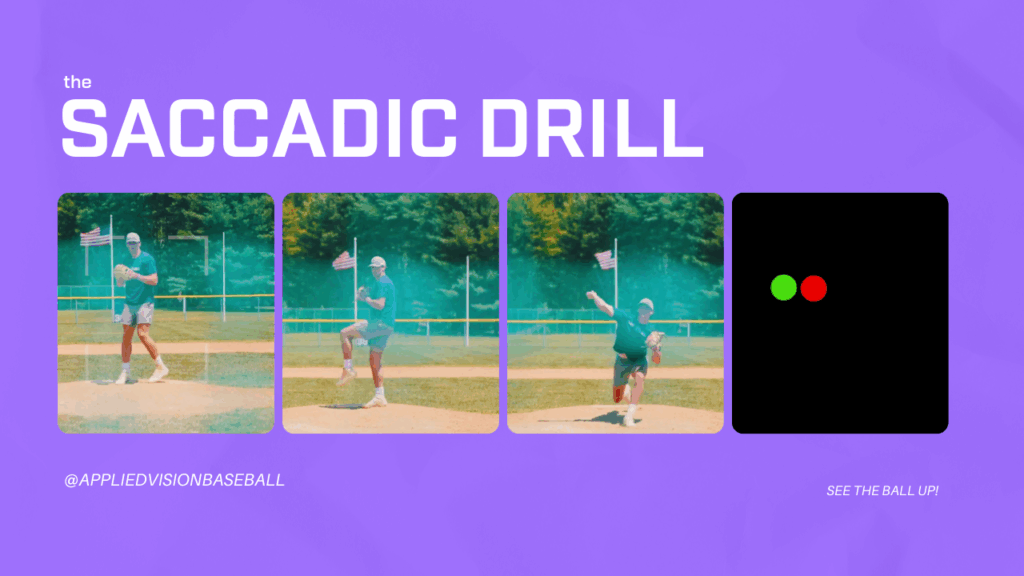
In the Saccadic Drill, vision is removed mid-flight just like the occlusion drill, but instead of guessing, you must locate the pitch.
After the screen goes black, two colored circles appear—one represents where the pitch would be at the point of contact, the other is incorrect. Your job is to choose the correct circle as quickly and accurately as possible.
This forces your eyes to make a rapid saccadic jump and your brain to predict the trajectory based on the limited information gathered early in flight. The drill sharpens spatial awareness, improves trajectory prediction, and trains hitters to trust early visual cues.
Over time, hitters become better at knowing where the ball will be—rather than chasing where it was—which leads to cleaner decisions and more consistent contact in real at-bats.
LESSON 4
HOW DOES THE APP WORK?
The AVB app simulates live at-bats with elite pitchers, across thousands of pitch sequences, and offers drills (occlusion, swing-trigger, soft-to-hard focus, pitch path prediction) to train your visual system to “read” the ball earlier.
You train your pitch-selection, swing decision, and prediction skills in the Applied Vision Baseball App by simulating 1,000's of different pitch-sequences.
Now you can compete in the batter’s box with calmness, toughness, and focus with the belief that you have what it takes to beat the pitcher.
WIN THE PITCH RECOGNITION BATTLE!
Simulate live at-bats on any device. Train the brain, then the swing.
50% of your vision is compromised at the plate when there's tension & anxiety in the body. Here's a solution. When your eyes improve, you improve.

© Applied Vision Baseball. All Rights Reserved